
.png)
#3 - Self-sacrificing Sand Pine
- Aug 17, 2022
- 2 min read
The members-only Walk on Wednesday had a wonderful field trip through the scrub at North Sebastian Conservation Area on October 27 2021.
As an ancient sand dune, this special Florida desert evolved 3 million years ago in the late Pleistocene epoch when most of the state was part of the ocean, which makes these places the oldest land masses in Florida.
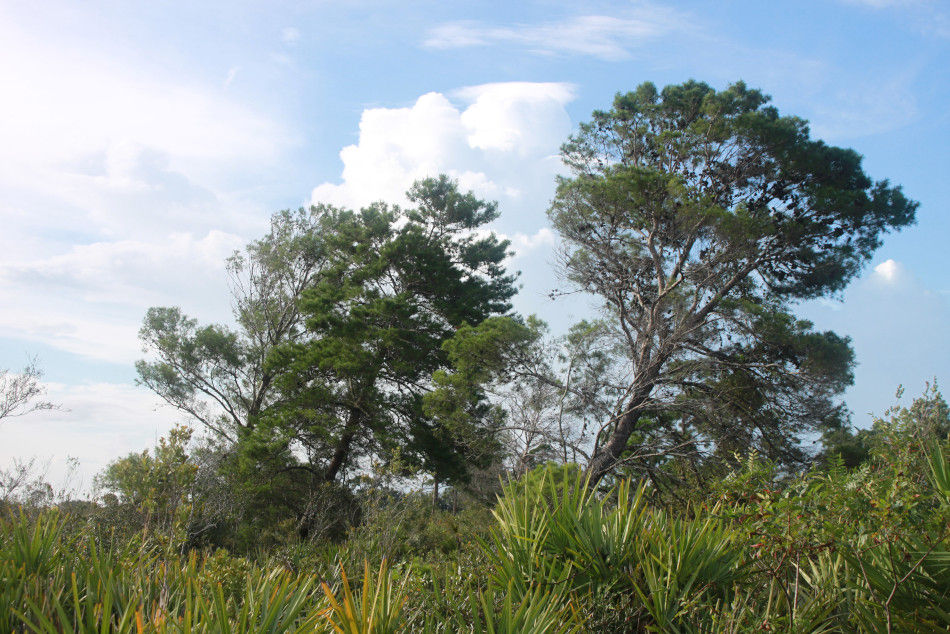
Some of this 407 acre property in Sebastian consists of beautiful, unspoiled sand pine scrub that is dominated by the eponymous Sand Pine (Pinus clausa). This outstanding, nearly endemic tree grows up to 60 feet tall and exclusively inhabits elevated and well drained areas in deep sandy soil. It can be identified by its relatively short needles and a trunk with small paper-like shingles. Sometimes the trunk can even be smooth and lack shingles entirely, which makes it a great medium for many species of crustose lichens (see photo).
Another ID-factor is that Sand Pine rarely grows straight up. With its fast growth rate it is formed by storms and almost constant easterly wind and therefore found mostly leaning towards the West on the East coast of Florida. This fact, coupled with its shallow root system, makes this tree prone to uprooting.
As part of a naturally pyrogenic (fire requiring) ecosystem, mature Sand Pines, unlike Slash Pine or Long Leaf Pine, usually don’t survive burns but the species itself requires fire for its reproduction. The serotinous (remaining closed on the tree) cones of the Central Florida variety usually stay tightly sealed by a hard cover of resin which has to be burned off to release the small anemophilous (wind dispersed) seeds. This adaptation makes it less likely for the fragile seedlings to get outcompeted for water and light by other shrubs or trees. In fact, it is sometimes only the death of the mature “mother” tree by way of hot, long-burning fire that allows the survival of its seedlings because that same fire also kills more fire-resistant plants and fertilizes the nutrient poor soil for the seedlings.


Comments